Recency Bias: Why the Latest Thing Feels Like the Whole Story
Recency bias makes the newest event feel more important than the pattern that came before it. One bad meeting can overshadow months of strong work, and one dramatic headline can reset how risky the world feels. The latest information may matter, but it should not automatically become the whole story.
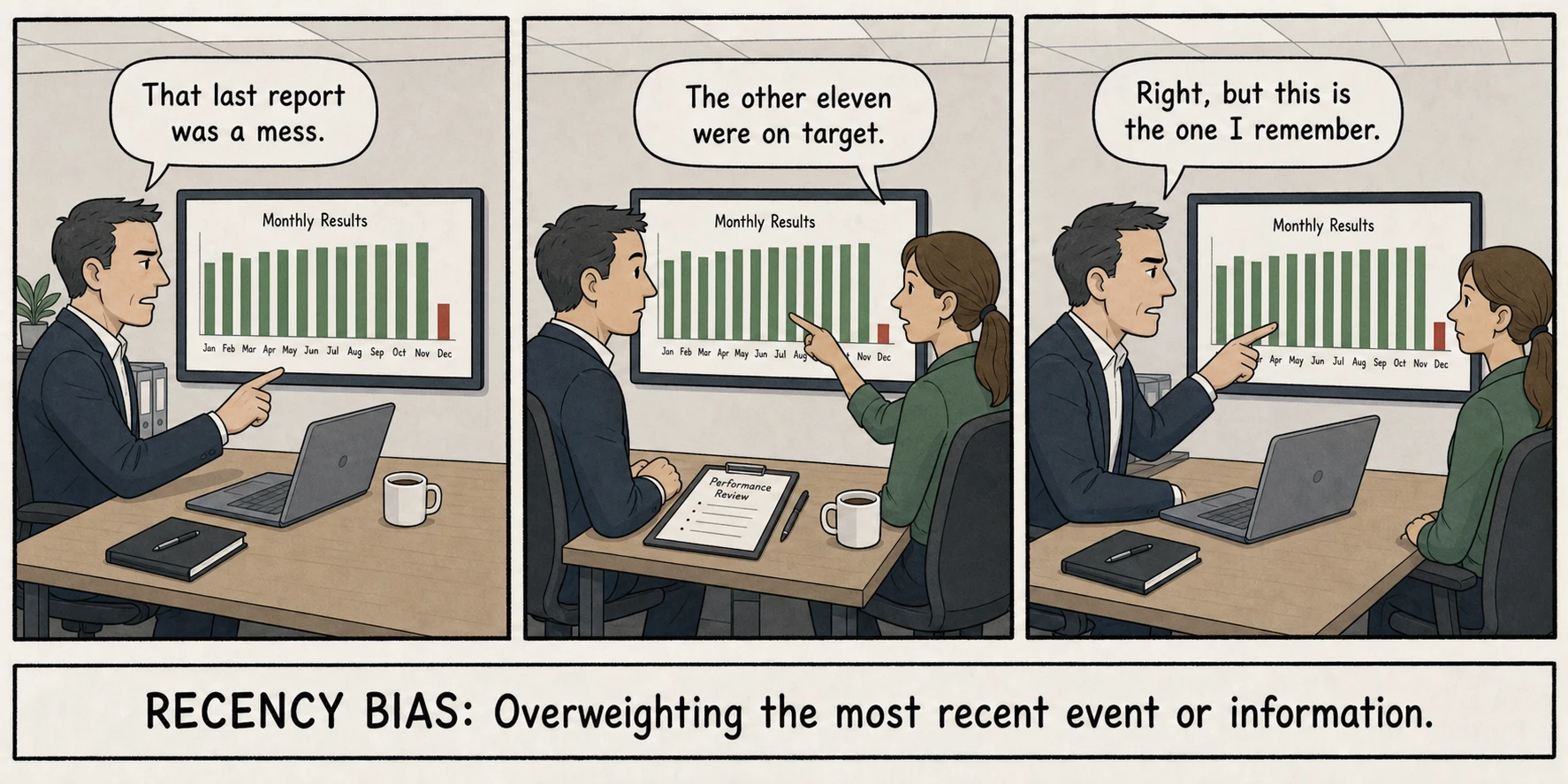
Overweighting the most recent event or information.
What Is Recency bias?
Recency bias is a thinking trap where overweighting the most recent event or information.
How It Tricks You
It can make a reconstructed memory feel like a clean recording.
Real-World Example
A great final interview makes a hiring manager forget earlier concerns.
Examples in Daily Life
Letting one difficult evening define an otherwise positive month.
Rating an employee mainly from the final weeks before a review instead of the full review period.
Treating the newest poll, game, headline, or viral clip as if it erased the larger trend.
Seen Online As
- The latest example is the one that matters most.
- After what just happened, everything before it feels irrelevant.
- That last impression completely changed how I see the whole thing.
Recency bias vs. Recency effect
The recency effect is a memory pattern in which the last items in a sequence are easiest to recall. Recency bias is the judgment error that occurs when recent information receives too much weight.
How To Reduce Recency bias
- Set the evaluation period before looking at the latest result.
- Use notes or records that cover the entire period.
- Ask whether the newest event changes the trend or merely sits at its end.
What To Ask Instead
Am I judging the whole pattern or only the latest moment?
Related Thinking Traps
Common Situations
Related Reading

Evidence and context
Research Basis
Reviewed August 25, 2026
Established memory effect; its influence on judgment depends on the task and evaluation window.
- The serial position effect of free recallB. B. Murdock Jr. · Journal of Experimental Psychology · 1962
- Two storage mechanisms in free recallM. Glanzer and A. R. Cunitz · Journal of Verbal Learning and Verbal Behavior · 1966
Sources establish the research basis for this guide. The examples and check questions are plain-language applications by Thinking Traps.
Quick FAQ
What is Recency bias?
Overweighting the most recent event or information.
What is an example of Recency bias?
A great final interview makes a hiring manager forget earlier concerns.
How do I spot Recency bias?
Am I judging the whole pattern or only the latest moment?
How can I reduce Recency bias?
Set the evaluation period before looking at the latest result. Use notes or records that cover the entire period. Ask whether the newest event changes the trend or merely sits at its end.