
Availability Heuristic: Why the First Example You Remember Feels Most Likely
The availability heuristic makes events seem more common or likely when examples come to mind easily. Vivid stories, repeated headlines, and recent experiences are easier to recall than quiet statistics. What is memorable can be useful evidence, but it is not automatically representative evidence.
Judging likelihood by how easily examples come to mind.
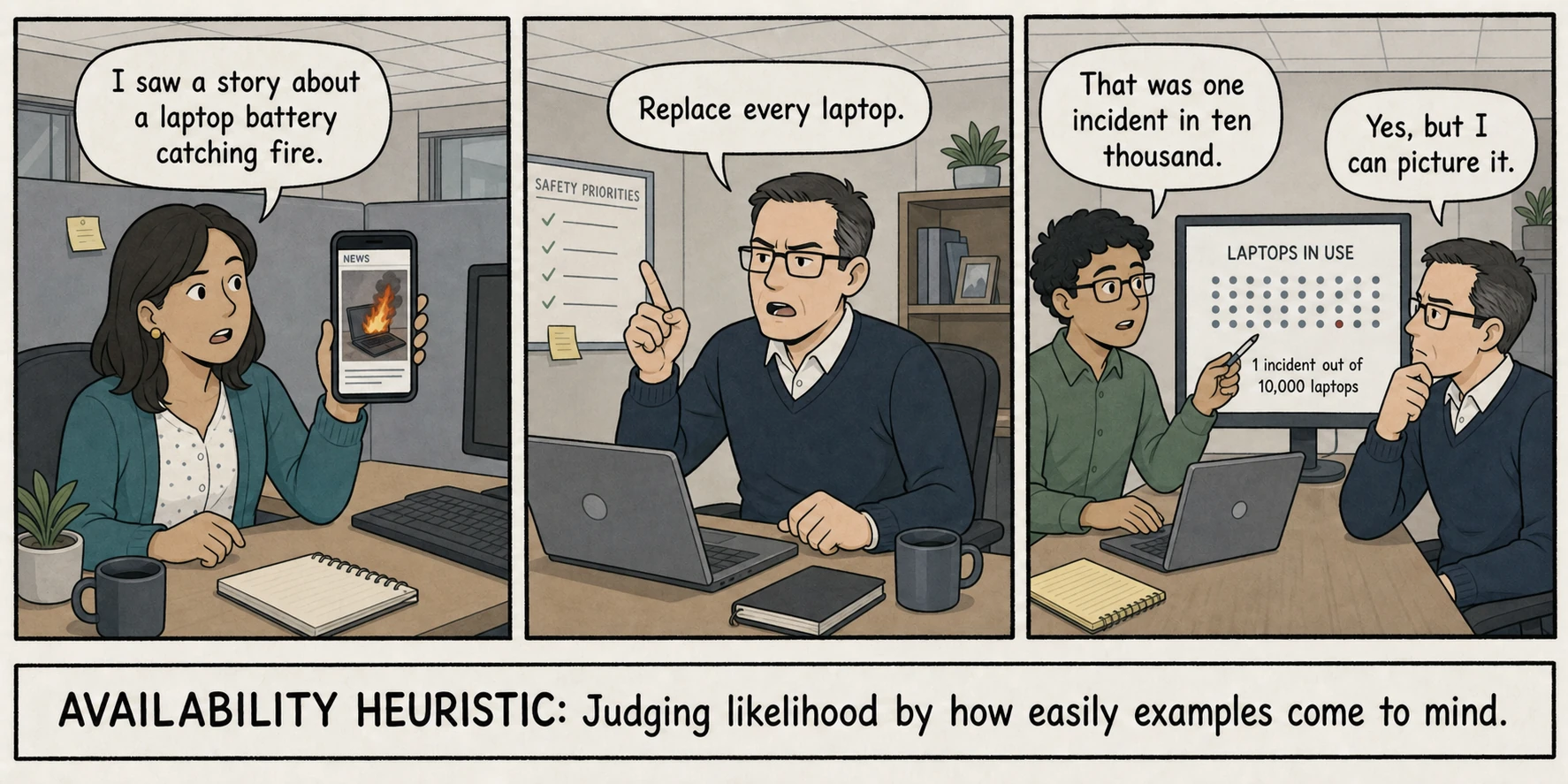
What Is Availability heuristic?
Availability heuristic is a thinking trap where judging likelihood by how easily examples come to mind.
How It Tricks You
It can make a reconstructed memory feel like a clean recording.
Real-World Example
After watching several stories about shark attacks, a beach trip suddenly feels much more dangerous.
Examples in Daily Life
Feeling that flying is unusually dangerous after seeing repeated coverage of one crash.
Treating the most memorable customer complaint as the most common problem without checking support data.
Assuming a dramatic behavior is widespread because several viral examples appeared in your feed.
Seen Online As
- I keep seeing stories about this, so it must be happening everywhere.
- That clip is all I can think about, so it feels like the normal case.
- It happened to someone I know, so the risk feels huge.
Availability heuristic vs. Salience bias
Salience bias gives extra weight to information that stands out. The availability heuristic uses whatever comes to mind easily as a shortcut for estimating frequency or probability.
How To Reduce Availability heuristic
- Ask for the underlying rate, not just a memorable example.
- Search for ordinary cases that would not become stories or posts.
- Separate how easy something is to recall from how often it occurs.
What To Ask Instead
Is this common, or just vivid and easy to remember?
Related Thinking Traps
Common Situations
Related Reading





Evidence and context
Research Basis
Reviewed August 25, 2026
Foundational judgment heuristic with important boundary conditions around recall, vividness, and environmental fit.
- Availability: A heuristic for judging frequency and probabilityA. Tversky and D. Kahneman · Cognitive Psychology · 1973
- Judgment under Uncertainty: Heuristics and BiasesA. Tversky and D. Kahneman · Science · 1974
Sources establish the research basis for this guide. The examples and check questions are plain-language applications by Thinking Traps.
Quick FAQ
What is Availability heuristic?
Judging likelihood by how easily examples come to mind.
What is an example of Availability heuristic?
After watching several stories about shark attacks, a beach trip suddenly feels much more dangerous.
How do I spot Availability heuristic?
Is this common, or just vivid and easy to remember?
How can I reduce Availability heuristic?
Ask for the underlying rate, not just a memorable example. Search for ordinary cases that would not become stories or posts. Separate how easy something is to recall from how often it occurs.