
Commitment Bias: When Changing Your Mind Feels Like Losing
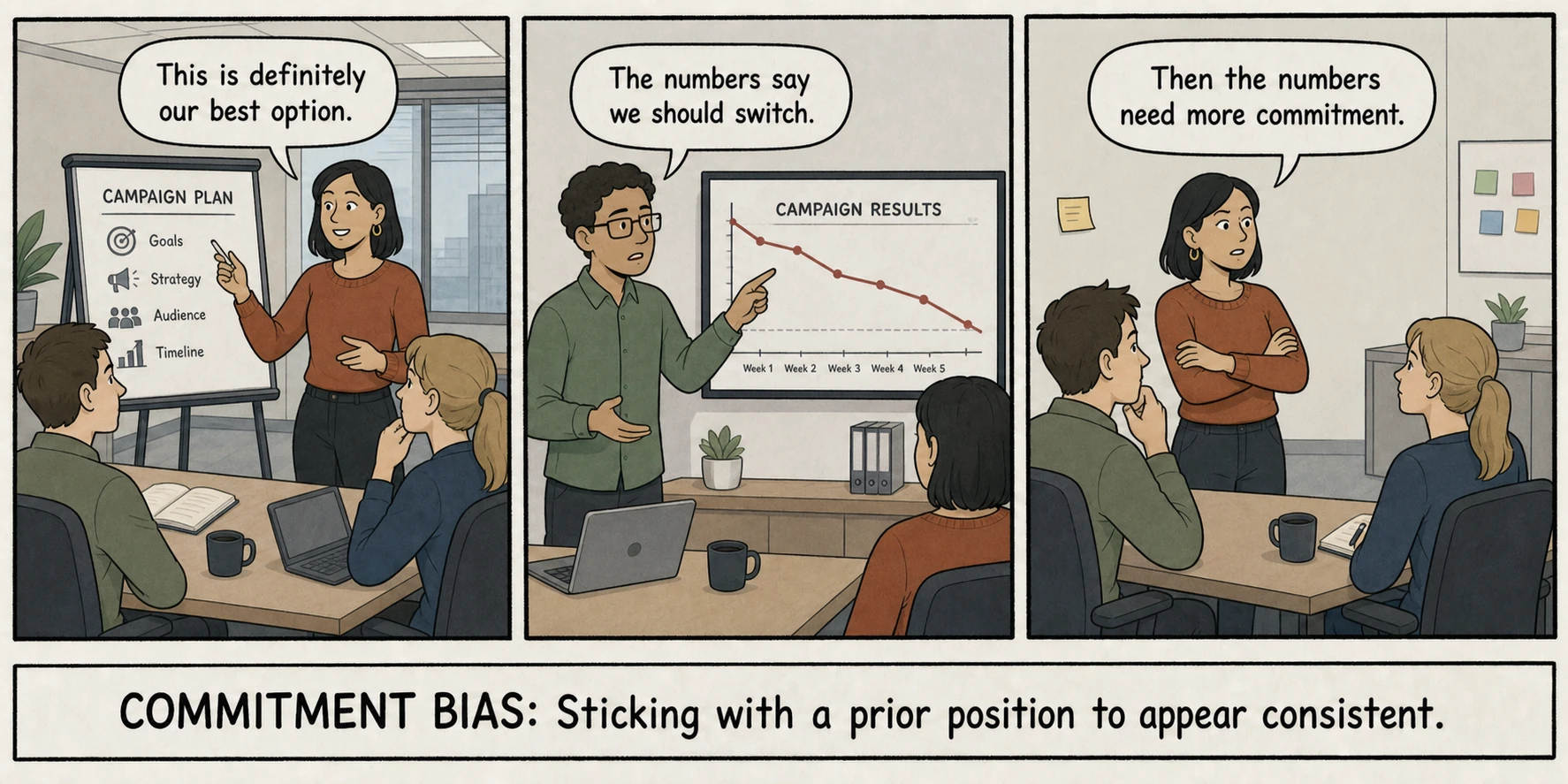
Commitment bias makes us defend an earlier choice because reversing course feels inconsistent, embarrassing, or weak. The more publicly we supported the decision, the harder it becomes to evaluate new evidence fairly. Consistency can be useful, but it should not outrank better information.
Sticking with a prior position to appear consistent.
What Is Commitment bias?
Commitment bias is a thinking trap where sticking with a prior position to appear consistent.
How It Tricks You
It can make value, price, ownership, or scarcity feel more objective than they really are.
Real-World Example
Someone keeps defending a public opinion after privately doubting it.
Examples in Daily Life
Continuing to defend a plan after privately realizing a different option would work better.
Supporting a weak initiative because you promoted it strongly in the previous meeting.
Doubling down on a post after new evidence appears because changing your mind feels like losing face.
Seen Online As
- The easiest option is starting to feel like the best one.
- I am defending the choice before comparing alternatives.
- The risk I can feel is louder than the risk I should calculate.
Commitment bias vs. Sunk cost fallacy
Sunk cost focuses on resources already spent. Commitment bias focuses on preserving consistency with a previous choice, statement, identity, or promise.
How To Reduce Commitment bias
- State what you would choose if no earlier position were public.
- Treat updating as evidence of judgment, not weakness.
- Set conditions in advance that would trigger reconsideration.
What To Ask Instead
What would I choose without the earlier commitment?
Related Thinking Traps
Common Situations
Related Reading


Evidence and context
Research Basis
Reviewed August 25, 2026
Supported by escalation-of-commitment research; public responsibility and self-justification can strengthen persistence.
- Knee-deep in the big muddy: A study of escalating commitment to a chosen course of actionB. M. Staw · Organizational Behavior and Human Performance · 1976
- Cleaning Up the Big Muddy: A Meta-Analytic Review of the Determinants of Escalation of CommitmentD. J. Sleesman, D. E. Conlon, G. McNamara, and J. E. Miles · Academy of Management Journal · 2012
Sources establish the research basis for this guide. The examples and check questions are plain-language applications by Thinking Traps.
Quick FAQ
What is Commitment bias?
Sticking with a prior position to appear consistent.
What is an example of Commitment bias?
Someone keeps defending a public opinion after privately doubting it.
How do I spot Commitment bias?
What would I choose without the earlier commitment?
How can I reduce Commitment bias?
State what you would choose if no earlier position were public. Treat updating as evidence of judgment, not weakness. Set conditions in advance that would trigger reconsideration.