
Status Quo Bias: Why 'Leave It Alone' Feels Safer Than Change
Status quo bias makes the current option feel safer simply because it is already in place. We notice the risks of changing while treating the costs of staying put as normal or invisible. The useful comparison is not change versus no risk; it is the future cost of each option.
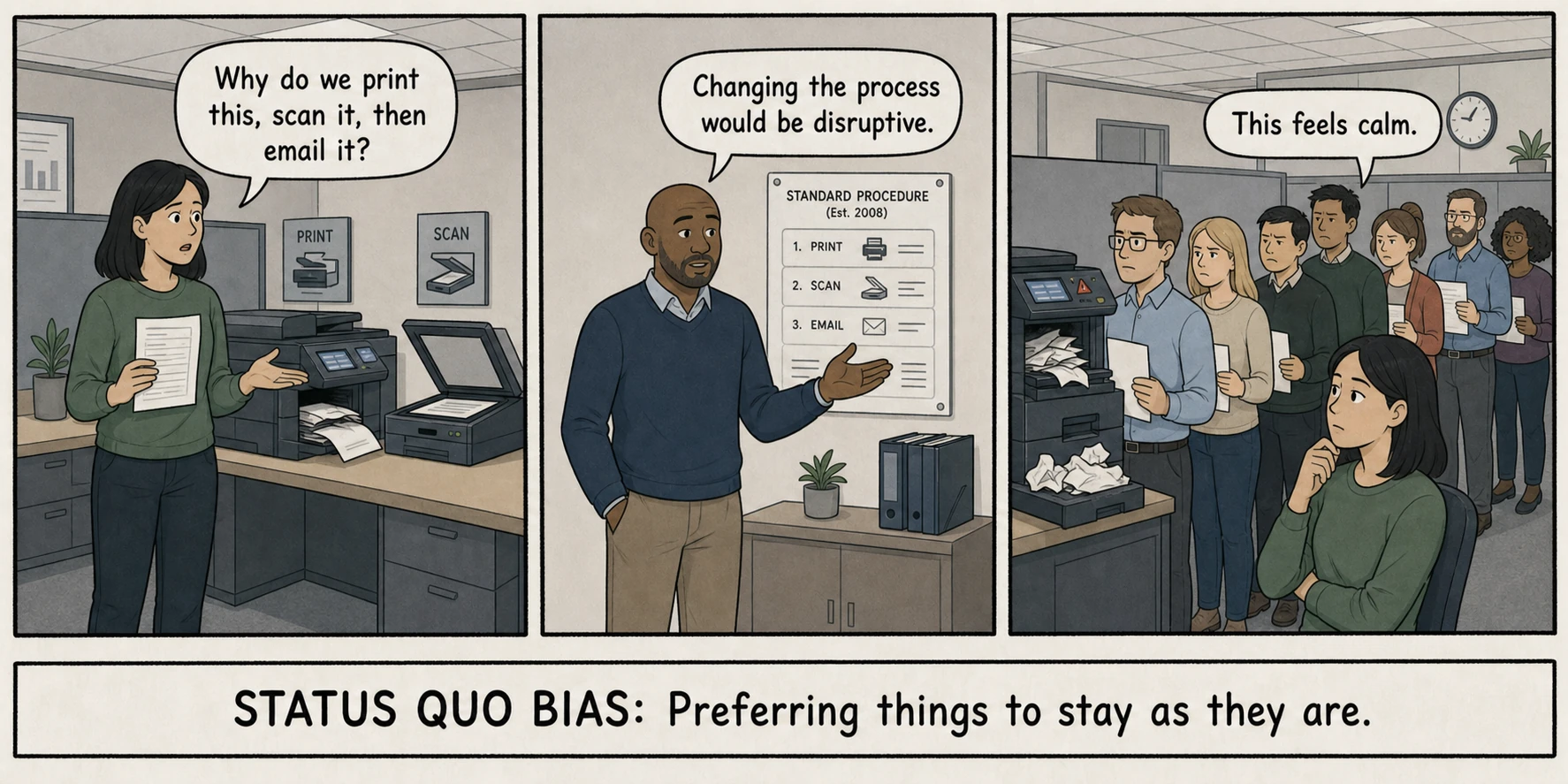
Preferring things to stay as they are.
What Is Status quo bias?
Status quo bias is a thinking trap where preferring things to stay as they are.
How It Tricks You
It can make one option feel obvious before the tradeoffs have been checked.
Real-World Example
An employee sticks with an old tool because changing workflows feels annoying.
Examples in Daily Life
Keeping an expensive subscription because canceling requires a decision, even though it is rarely used.
Continuing a slow approval process because it is familiar and no single person wants responsibility for changing it.
Treating the platform or tool already installed as the best option without comparing alternatives.
Seen Online As
- Changing it sounds riskier than leaving it alone.
- This is how we have always done it.
- The current option feels safer mostly because it is current.
Status quo bias vs. Default effect
The default effect concerns a preselected option. Status quo bias is broader: the current arrangement can feel preferable even when nobody explicitly selected it for you.
How To Reduce Status quo bias
- Describe the current option as if it were a new proposal.
- Compare the cost of changing with the cost of staying put.
- Set a review date so inertia does not become a permanent decision.
What To Ask Instead
Would I choose this if it were not already the default?
Related Thinking Traps
Common Situations
Related Reading
Evidence and context
Research Basis
Reviewed August 25, 2026
Well-established decision pattern, with effects shaped by switching costs, uncertainty, and loss aversion.
- Status quo bias in decision makingW. Samuelson and R. Zeckhauser · Journal of Risk and Uncertainty · 1988
- Anomalies: The Endowment Effect, Loss Aversion, and Status Quo BiasD. Kahneman, J. L. Knetsch, and R. H. Thaler · Journal of Economic Perspectives · 1991
Sources establish the research basis for this guide. The examples and check questions are plain-language applications by Thinking Traps.
Quick FAQ
What is Status quo bias?
Preferring things to stay as they are.
What is an example of Status quo bias?
An employee sticks with an old tool because changing workflows feels annoying.
How do I spot Status quo bias?
Would I choose this if it were not already the default?
How can I reduce Status quo bias?
Describe the current option as if it were a new proposal. Compare the cost of changing with the cost of staying put. Set a review date so inertia does not become a permanent decision.