
Out-group homogeneity bias
Seeing outsiders as more alike than they are.
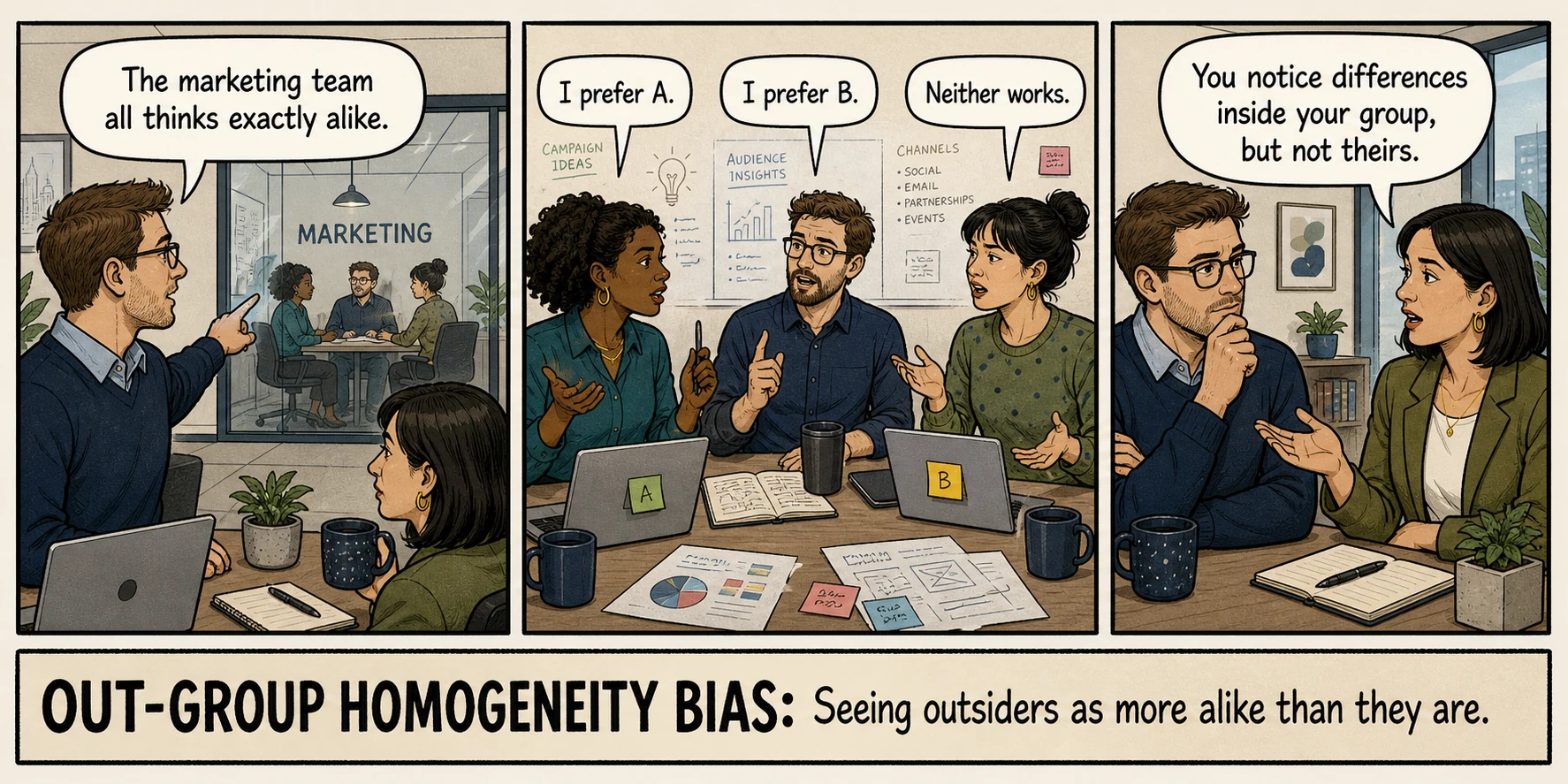
What Is Out-group homogeneity bias?
Out-group homogeneity bias is a thinking trap where seeing outsiders as more alike than they are.
How It Tricks You
It can turn partial social evidence into a confident judgment about people, motives, or groups.
Real-World Example
Someone says all members of another department think the same way.
Examples in Daily Life
Describing another generation as if its millions of members share one personality and set of priorities.
Assuming people from another department all think alike while noticing every difference inside your own team.
Using one extreme post to summarize an entire political, cultural, or professional group.
Seen Online As
- They all think the same way.
- People like that are basically interchangeable.
- I am treating a whole group like one personality.
Out-group homogeneity bias vs. Stereotyping
Stereotyping assigns assumed traits to members of a group. Out-group homogeneity bias is the prior perception that members of an outside group are unusually similar to one another.
How To Reduce Out-group homogeneity bias
- Replace group labels with specific people, claims, or behaviors.
- Look deliberately for disagreement and variation within the group.
- Compare the diversity you grant your own group with the diversity you grant others.
What To Ask Instead
What differences inside that group am I missing?
Related Thinking Traps
Common Situations
Related Reading


Evidence and context
Research Basis
Reviewed August 25, 2026
Established social-perception effect; its size changes with familiarity, group structure, and social context.
- The perception of variability within in-groups and out-groups: Implications for the law of small numbersG. A. Quattrone and E. E. Jones · Journal of Personality and Social Psychology · 1980
- Perception of out-group homogeneity and levels of social categorizationB. Park and M. Rothbart · Journal of Personality and Social Psychology · 1982
Sources establish the research basis for this guide. The examples and check questions are plain-language applications by Thinking Traps.
Quick FAQ
What is Out-group homogeneity bias?
Seeing outsiders as more alike than they are.
What is an example of Out-group homogeneity bias?
Someone says all members of another department think the same way.
How do I spot Out-group homogeneity bias?
What differences inside that group am I missing?
How can I reduce Out-group homogeneity bias?
Replace group labels with specific people, claims, or behaviors. Look deliberately for disagreement and variation within the group. Compare the diversity you grant your own group with the diversity you grant others.