
Money illusion
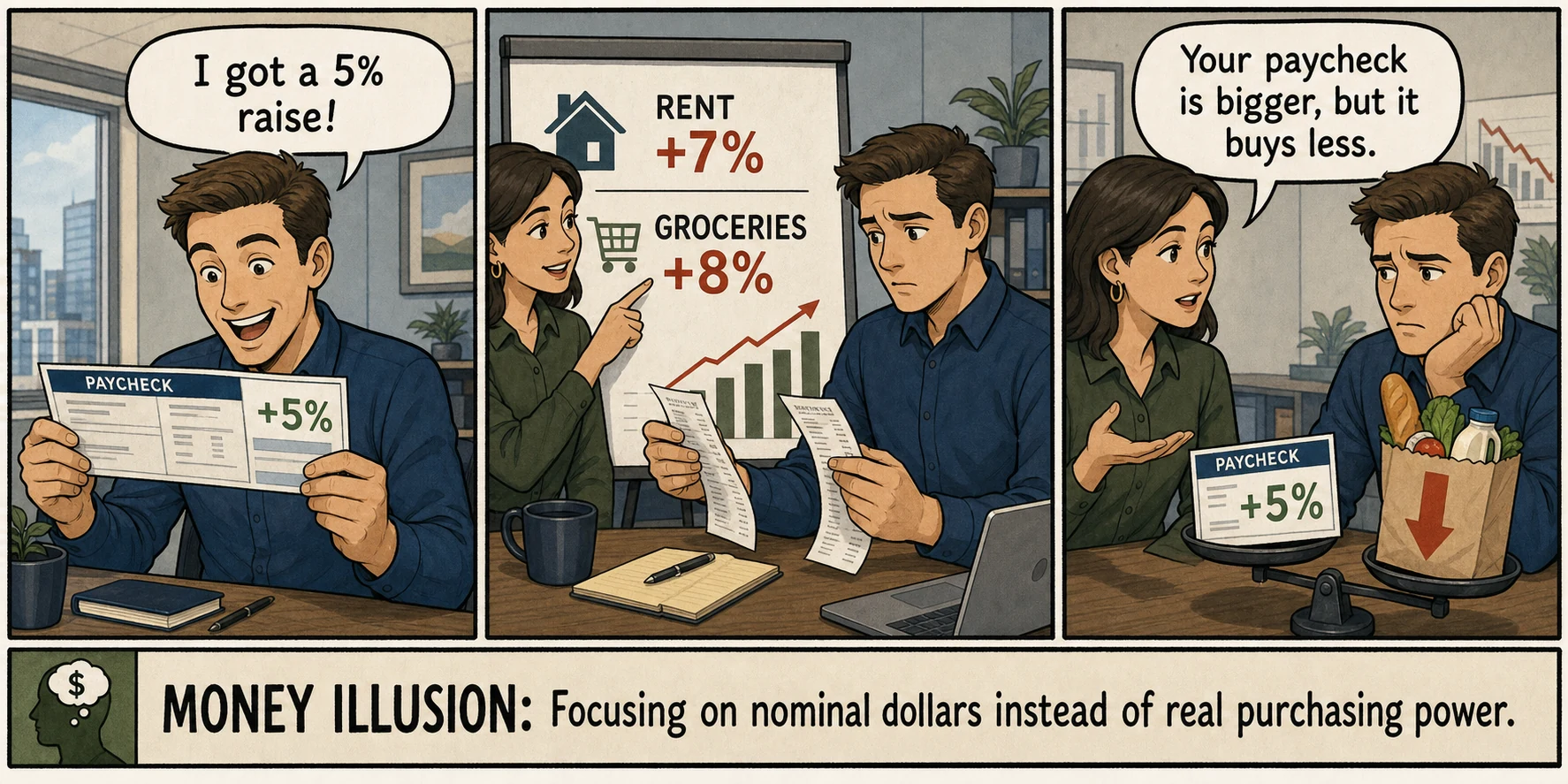
Focusing on nominal dollars instead of real purchasing power.
What Is Money illusion?
Money illusion is a thinking trap where focusing on nominal dollars instead of real purchasing power.
How It Tricks You
It can make value, price, ownership, or scarcity feel more objective than they really are.
Real-World Example
A raise feels bigger until rent and prices rise too.
Examples in Daily Life
Feeling richer after a raise without comparing it with increases in rent, food, insurance, and taxes.
Calling a budget larger because its dollar amount rose even though costs rose faster.
Comparing salaries, home prices, or market values from different years without adjusting for purchasing power.
Seen Online As
- The deal is making the decision feel smarter than it is.
- The payment feels small enough not to count.
- I am judging value before checking whether I need it.
Money illusion vs. Anchoring bias
Anchoring gives an initial number excessive influence. Money illusion specifically mistakes nominal dollar changes for changes in real value or purchasing power.
How To Reduce Money illusion
- Compare amounts in the same year's purchasing power.
- Calculate the after-inflation return or wage change.
- Translate the number into the goods, time, or obligations it can actually cover.
What To Ask Instead
What is this worth after inflation or context?
Related Thinking Traps
Common Situations
Related Reading


Evidence and context
Research Basis
Reviewed August 25, 2026
Established behavioral-economics finding; sensitivity to nominal values varies with experience and market context.
- Money IllusionE. Shafir, P. Diamond, and A. Tversky · The Quarterly Journal of Economics · 1997
- Does Money Illusion Matter?E. Fehr and J.-R. Tyran · American Economic Review · 2001
Sources establish the research basis for this guide. The examples and check questions are plain-language applications by Thinking Traps.
Quick FAQ
What is Money illusion?
Focusing on nominal dollars instead of real purchasing power.
What is an example of Money illusion?
A raise feels bigger until rent and prices rise too.
How do I spot Money illusion?
What is this worth after inflation or context?
How can I reduce Money illusion?
Compare amounts in the same year's purchasing power. Calculate the after-inflation return or wage change. Translate the number into the goods, time, or obligations it can actually cover.