
Planning Fallacy: Why 'It'll Only Take an Hour' Rarely Does
The planning fallacy makes us picture the smoothest path through a project while overlooking interruptions, revisions, dependencies, and ordinary bad luck. Even when similar work ran late before, the current plan feels different. A better estimate starts with what comparable projects actually required.
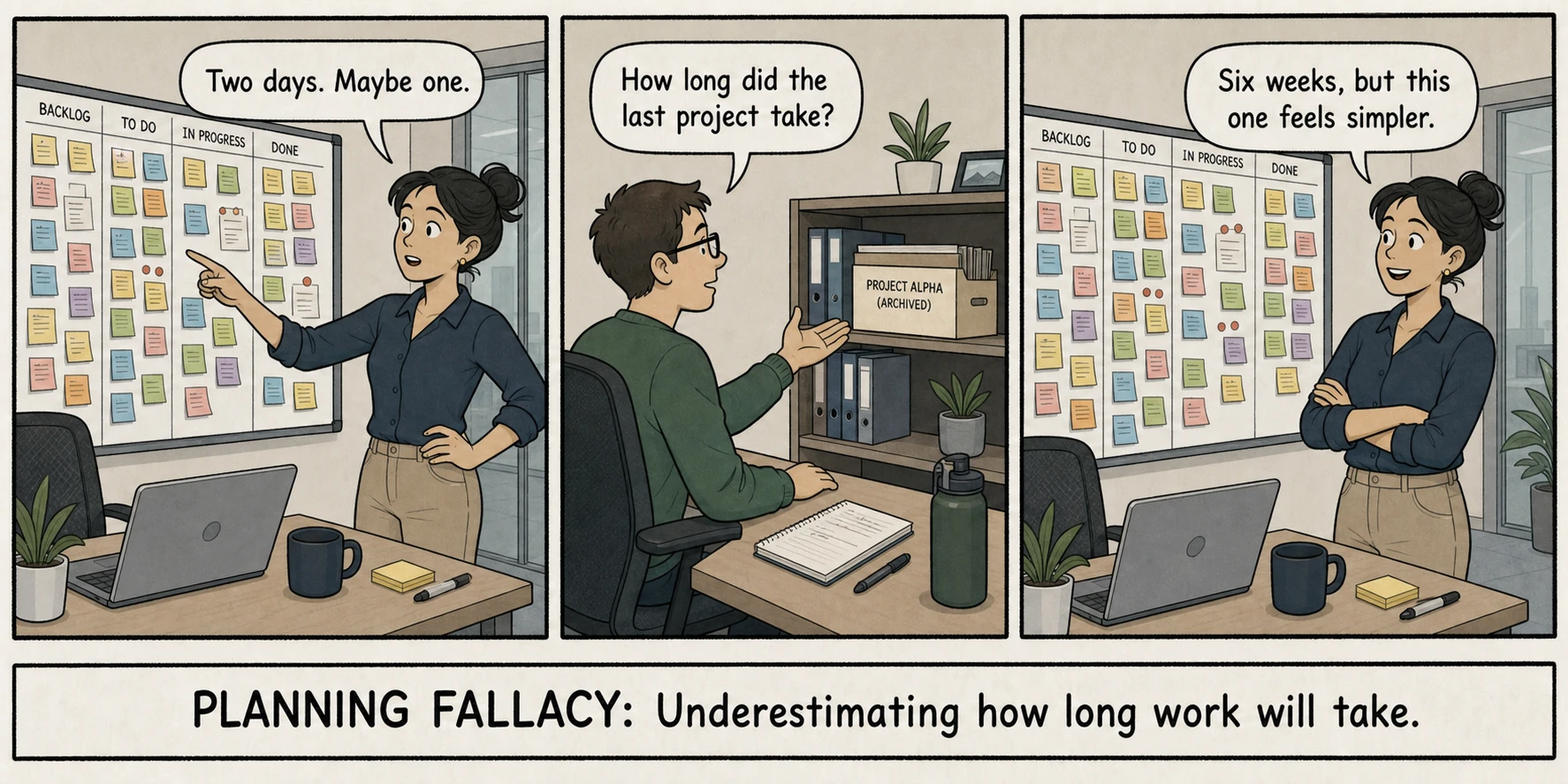
Underestimating how long work will take.
What Is Planning fallacy?
Planning fallacy is a thinking trap where underestimating how long work will take.
How It Tricks You
It can make one option feel obvious before the tradeoffs have been checked.
Real-World Example
A weekend closet project quietly becomes a three-week project.
Planning Fallacy Examples
Examples in Daily Life
Assuming a weekend home project will take two hours while ignoring shopping, setup, cleanup, and surprises.
Building a deadline from the best-case sequence instead of the actual duration of comparable projects.
Announcing that a complicated product or policy will be finished quickly because each individual step sounds simple.
Seen Online As
- This should only take an hour.
- We will finish faster this time because we know what we are doing.
- The best-case timeline feels like the realistic one.
Planning fallacy vs. Optimism bias
Optimism bias is a general tendency to expect favorable outcomes. The planning fallacy specifically underestimates the time, cost, or difficulty required to complete a task.
How To Reduce Planning fallacy
- Use completion times from comparable finished projects.
- Estimate the full workflow, including handoffs and recovery from mistakes.
- Choose a likely range instead of one confident deadline.
What To Ask Instead
How long did similar work actually take before?
Related Thinking Traps
Common Situations
Evidence and context
Research Basis
Reviewed August 25, 2026
Well-established forecasting error; using comparable completed projects can substantially improve estimates.
- Exploring the Planning Fallacy: Why People Underestimate Their Task Completion TimesR. Buehler, D. Griffin, and M. Ross · Journal of Personality and Social Psychology · 1994
- Timid Choices and Bold Forecasts: A Cognitive Perspective on Risk TakingD. Kahneman and D. Lovallo · Management Science · 1993
Sources establish the research basis for this guide. The examples and check questions are plain-language applications by Thinking Traps.
Quick FAQ
What is Planning fallacy?
Underestimating how long work will take.
What is an example of Planning fallacy?
A weekend closet project quietly becomes a three-week project.
How do I spot Planning fallacy?
How long did similar work actually take before?
How can I reduce Planning fallacy?
Use completion times from comparable finished projects. Estimate the full workflow, including handoffs and recovery from mistakes. Choose a likely range instead of one confident deadline.
What are common Planning fallacy examples?
Software launch: The team estimates two weeks for development but leaves out testing, revisions, and approval delays. Home renovation: A weekend painting project expands after furniture must be moved, walls repaired, and supplies replaced. Writing assignment: Someone budgets only for drafting and forgets research, editing, formatting, and feedback. Work meeting: A 30-minute agenda assumes every topic will be resolved without questions or side discussions. Travel preparation: Packing is estimated from the act of filling a suitcase, not laundry, finding documents, or last-minute errands. Event planning: The schedule includes the visible tasks but misses vendor coordination, setup problems, and follow-up decisions.