
Belief perseverance
Holding a belief after its support has been weakened.
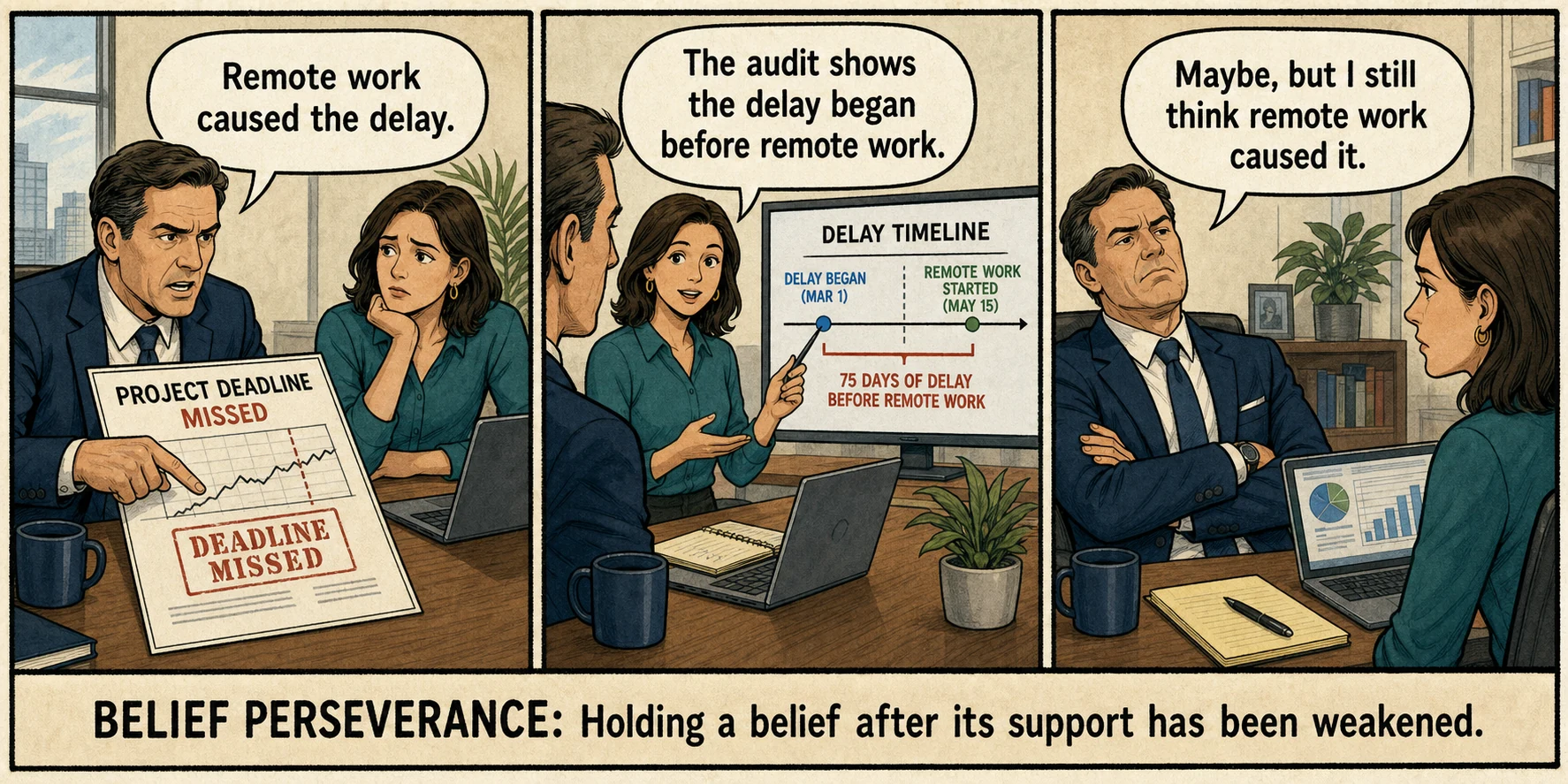
What Is Belief perseverance?
Belief perseverance is a thinking trap where holding a belief after its support has been weakened.
How It Tricks You
It can make a conclusion feel proven because it fits what already seems true.
Real-World Example
A corrected rumor keeps shaping someone's opinion.
Examples in Daily Life
Continuing to distrust someone after learning that the accusation which formed the impression was mistaken.
Keeping an early judgment of an employee after the performance evidence that supported it has changed.
Remembering the emotional conclusion of a false post even after seeing a correction or retraction.
Seen Online As
- The fast interpretation is doing more work than the evidence.
- The claim feels obvious before the check question is asked.
- A shortcut is making the judgment feel more certain than it is.
Belief perseverance vs. Confirmation bias
Confirmation bias favors information that supports an existing belief. Belief perseverance describes the belief remaining in place even after the evidence that created it has been removed.
How To Reduce Belief perseverance
- Identify the original evidence that produced the belief.
- Ask what the belief would rest on if that evidence vanished.
- Replace a false explanation with a supported alternative rather than only labeling it wrong.
What To Ask Instead
What evidence originally convinced me?
Related Thinking Traps
Common Situations
Related Reading


Evidence and context
Research Basis
Reviewed August 25, 2026
Established persistence effect; replacing a discredited explanation is often more effective than correction alone.
- Perseverance in self-perception and social perceptionL. Ross, M. R. Lepper, and M. Hubbard · Journal of Personality and Social Psychology · 1975
- Perseverance of social theories: The role of explanation in the persistence of discredited informationC. A. Anderson, M. R. Lepper, and L. Ross · Journal of Personality and Social Psychology · 1980
Sources establish the research basis for this guide. The examples and check questions are plain-language applications by Thinking Traps.
Quick FAQ
What is Belief perseverance?
Holding a belief after its support has been weakened.
What is an example of Belief perseverance?
A corrected rumor keeps shaping someone's opinion.
How do I spot Belief perseverance?
What evidence originally convinced me?
How can I reduce Belief perseverance?
Identify the original evidence that produced the belief. Ask what the belief would rest on if that evidence vanished. Replace a false explanation with a supported alternative rather than only labeling it wrong.